
Teen Patti, the “Indian Poker,” transcends being merely a card game—it’s a vibrant social tradition, a festival centerpiece, and a thrilling test of nerve and intuition. This definitive guide merges deep strategic knowledge with accessible explanation, designed to take you from curious observer to confident player.
1. The Soul of the Game: More Than Just Cards
Before dealing the first card, understand what you’re participating in. Teen Patti is intrinsically linked to celebrations like Diwali, where playing is considered auspicious. It’s a game played in homes, at weddings, and increasingly, on digital platforms that connect the global diaspora. Its magic lies in a perfect balance: simple enough for anyone to learn, deep enough to fascinate for a lifetime.
2. Core Rules Demystified: Your Foundation for Play
2.1 The Absolute Basics
- The Deck: Standard 52 cards, no jokers (in the classic version).
- The Deal: Each player gets 3 cards, face down.
- The Goal: End the round with the best 3-card hand, or be the last player standing after all others fold.
- The Flow: Play moves clockwise around the table.
2.2 The Gameplay Sequence: A Detailed Walkthrough
Here is the complete lifecycle of a Teen Patti round, integrating the key “Blind vs. Seen” dynamic:
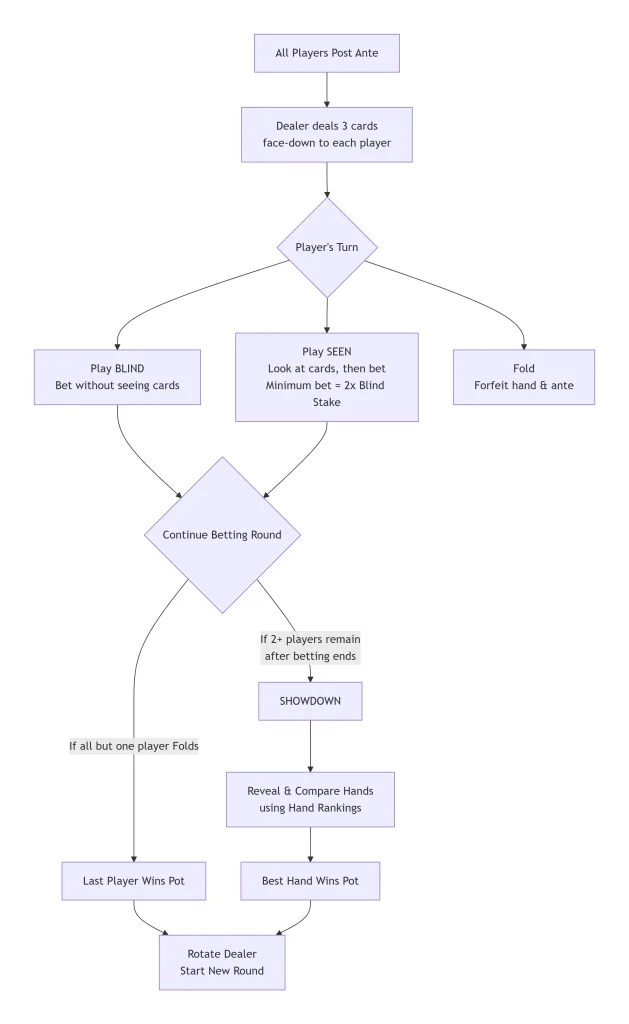
Key Dynamic Explained: The Blind player operates from a position of mystery, able to bluff effectively. The Seen player has information but pays a premium (double the bet) to stay in the round. A Seen player can challenge a Blind player to a showdown by paying a “show” fee, but not vice-versa. This creates a brilliant psychological tug-of-war.
3. The Language of Hands: Ranking & Probability
Knowing what beats what is non-negotiable. This table lists hands from strongest to weakest, with crucial examples and the odds of being dealt them.
| Rank | Hand Name | What It Is | Example | Approx. Probability | Tie-Breaker Rule |
|---|---|---|---|---|---|
| 1 | Trail/Set (Three of a Kind) | Three cards of identical rank. | A♠ A♥ A♦ | 0.24% | Higher-ranked triplet wins. Aces are highest. |
| 2 | Pure Sequence (Straight Flush) | Three consecutive cards of the same suit. | J♣ Q♣ K♣ | 0.22% | Compare the highest card in the sequence. |
| 3 | Sequence/Straight | Three consecutive cards of mixed suits. | 8♠ 9♥ 10♦ | 3.26% | Compare the highest card. A-2-3 is a valid low sequence. |
| 4 | Color/Flush | Three cards of the same suit, not in sequence. | 2♥ 7♥ K♥ | 4.96% | Compare the highest card. If equal, go to the next. |
| 5 | Pair | Two cards of identical rank. | Q♠ Q♦ 5♣ | 16.94% | Higher pair wins. If equal, compare the “kicker” (odd card). |
| 6 | High Card | None of the above. | A♣ 9♦ 4♥ | 74.39% | Compare highest card, then second, then third. |
Instant Insight: Notice that over 74% of dealt hands are simple “High Card” hands. This is why bluffing is so powerful and why a medium pair is often a very strong hand.
4. Strategic Playbook: From Beginner to Tactical Thinker
Move beyond luck with these layered strategies.
Level 1: Foundational Habits (For Beginners)
- Start Blind: Your first few rounds, play blind. It’s cheaper, lets you observe table dynamics, and masks your inexperience.
- Fold Weak Seen Hands: If you look at your cards and see only a high card (no pair), folding is usually the wisest, most economical choice.
- Watch the Clock: Notice who bets quickly and who hesitates. Timing tells are often more reliable than “poker faces.”
Level 2: Intermediate Tactics
- Leverage Your Position: Acting last in a betting round is a huge advantage. You’ve seen how others have acted before making your decision. Be more aggressive from late position.
- Build a Table Image: Are you playing tight (only strong hands) or loose (many hands)? Consciously craft an image, then use it to deceive. Let others see you fold for a while, then bluff aggressively.
- Manage Your Stack: Don’t commit a large portion of your chips without a strong hand or a very convincing bluff narrative.
Level 3: Advanced Psychological Plays
- The Selective Bluff: The best bluffs happen when the “story” makes sense. If the board (community cards in variants) or betting pattern suggests you could have a strong hand, your bluff is more believable.
- Identify Player Types: Is someone a “calling station” who never folds? Value bet them relentlessly with good hands. Is someone a “nit” who only plays premiums? Steal their blinds/antes when they are passive.
- Pot Odios & Expected Value (EV): In crucial calls, think: “How much is in the pot vs. how much do I need to call?” If the pot is 500 and you must call 100, you’re getting 5-to-1 odds. You only need to win about 17% of the time for this to be a profitable long-term call.
5. Popular Variations: Spice Up the Game
| Variation | Core Twist | Strategic Shift |
|---|---|---|
| AK47 | Aces, Kings, 4s, and 7s are wild. | Hand values skyrocket. Trails become common. Bluffing is riskier. |
| Joker Teen Patti | 1-2 Joker cards are added to the deck. | Similar to AK47. Focus shifts to making the absolute best hand possible. |
| Muflis (Lowball) | The worst hand wins. Rankings are inverted. | A perfect low hand is 2-3-5 of different suits. Pairs and flushes become bad! A complete mindset flip. |
| 999 | Hands are valued based on their sum of points (face cards = 0), aiming for 9 or closest. | A unique blend of Teen Patti and Baccarat. Number cards become crucial. |
6. Teen Patti in the Ecosystem: How It Compares
This comparison helps you understand where Teen Patti fits in the world of card games.
| Aspect | Teen Patti | Andar Bahar | Texas Hold’em Poker |
|---|---|---|---|
| Core Skills | Psychology, Bluffing, Intuition | Pure Luck, Patience | Math, Range Analysis, Long-term Strategy |
| Player Agency | High – constant decisions | None – bet and watch | Very High – strategic at every stage |
| Game Length | Very Fast (1-3 min/round) | Instant (20-60 sec/round) | Slow (5-15+ min/round) |
| Learning Curve | Gentle – Rules are simple | Minimal – No rules to learn | Steep – Complex concepts |
| Social Vibe | High-Energy, Festive | Casual, Relaxed | Competitive, Analytical |
| Best For | Social gatherings, quick thrill, cultural immersion | A fun, zero-stress side bet | Deep strategic engagement, tournaments |
7. The Unwritten Rules: Etiquette & Fair Play
- Cards on the Table: Keep your cards in clear view, not in your lap.
- One Motion, One Action: Touching your chips with intention is often considered a binding bet.
- Act in Turn: Don’t jump the gun or comment on a hand while others are deciding.
- Respect the Show: In a showdown, the player who was called or raised shows first.
- Online Integrity: Choose platforms with Random Number Generator (RNG) certifications for fair play.
Final Word: Embrace the Journey
Teen Patti is a beautiful confluence of chance and skill, tradition and modernity. Start by enjoying the social rhythm and the thrill of the unknown. Gradually, layer in the strategies and observations. Remember that the most important skill, beyond any bluff, is responsible play. Set limits for your time and money before you begin.
Whether under the festive lights of Diwali or on your smartphone screen, may the cards bring you excitement, camaraderie, and just the right amount of lucky fortune. Shubh kaamnaayein! (Best wishes!)